Best API Gateway Alternatives for Small Teams in 2026
Kong, AWS API Gateway, and Nginx are powerful — but they're built for platform teams. Here are the best API gateway alternatives for teams who just need rate limiting, visibility, and control without the ops burden.
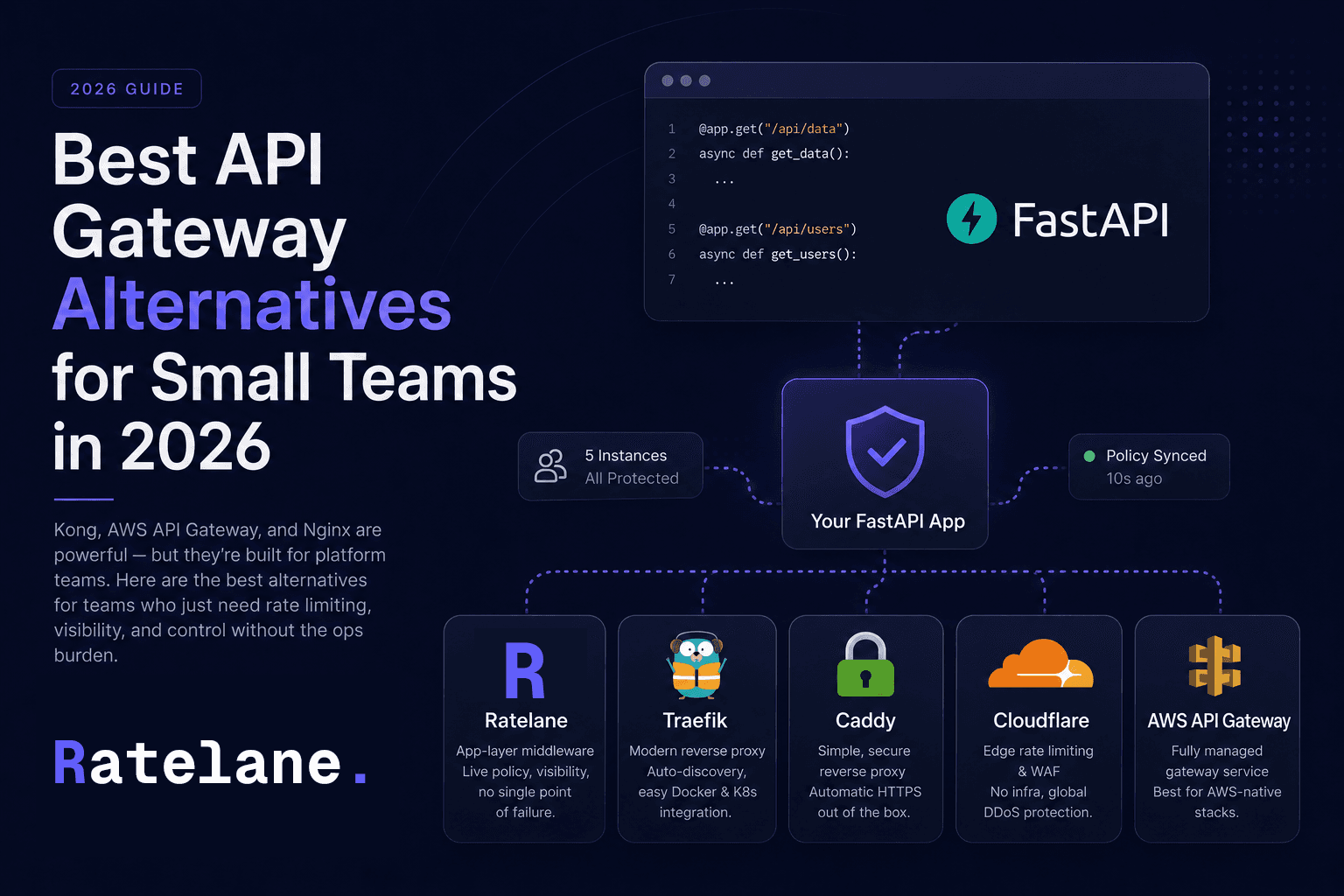
API gateways were designed for large organizations with dedicated platform teams. If you're running a product team of 2-10 engineers, the operational overhead of managing Kong, AWS API Gateway, or a full service mesh often outweighs the benefits.
Most small teams don't need a gateway. They need rate limiting, some visibility into what their API is doing, and the ability to change behavior without a redeploy. Those are different problems — and there are better tools for them.
This guide covers the best API gateway alternatives in 2026 for teams who want control without the complexity.
Why teams outgrow (or skip) traditional API gateways
Traditional gateways have a few structural problems for small teams:
They're a single point of failure. Kong, Nginx, or any proxy-layer gateway sits in front of every request. If it goes down, your API goes down. Managing gateway uptime becomes a new problem on top of your existing infrastructure.
Config changes require a reload or redeploy. Want to drop a rate limit from 100 to 20 requests per minute during an incident? On Kong you're hitting the admin API or reloading config. On Nginx you're reloading the process. Neither is instant, and neither is something you want to think about during an active incident.
They add latency. Every request goes through an extra network hop. For most apps this is single-digit milliseconds, but it's real, and it adds up at scale.
No visibility into your app instances. A gateway tells you about traffic at the edge. It doesn't tell you which of your 5 running app instances is stale, which picked up the latest policy, or which is on a fallback config.
The alternatives
1. Ratelane — app-layer middleware
Ratelane runs inside your app as middleware instead of in front of it. The SDK syncs policy from a dashboard every 10 seconds and enforces it locally — rate limits, IP rules, circuit breakers, CORS, route enable/disable — all without a live network call at request time.
What it solves differently from a gateway:
- No single point of failure — enforcement happens inside every app instance independently. If Ratelane's servers go down, your instances fall back to an Emergency Profile and keep running
- Live changes without redeploys — change any limit or rule from the dashboard, propagates to all instances in under 10 seconds
- Fleet visibility — see every running instance, its sync status, and what policy it's enforcing in real time. No gateway gives you this
- Zero latency overhead — enforcement is against a locally cached policy, not a remote call
Best for: Teams running FastAPI, Express, Fastify, or Hono who want rate limiting and policy control without managing gateway infrastructure.
Not for: Teams who need protocol transformation, complex routing rules, or service mesh features — those are gateway concerns, not Ratelane's focus.
2. Traefik
Traefik is a modern reverse proxy and load balancer that auto-discovers services. It's significantly easier to operate than Kong and integrates natively with Docker and Kubernetes.
Pros:
- Auto-configuration via labels — no separate config file per service
- Built-in Let's Encrypt support
- Good middleware ecosystem (rate limiting, auth, headers)
- Much lower ops burden than Kong
Cons:
- Still a proxy layer — same single-point-of-failure concern
- Rate limiting is per-instance of Traefik, not shared across a distributed Traefik setup without Redis
- No visibility into your app instances — only into traffic at the edge
- Config changes via labels still require container restarts in some setups
Best for: Teams already using Docker Compose or Kubernetes who want a self-managed proxy that's easier than Nginx to configure.
3. Caddy
Caddy is an open-source web server and reverse proxy with automatic HTTPS. It's the simplest proxy to operate — config is a single Caddyfile, HTTPS is automatic, and it handles common use cases well.
Pros:
- Automatic HTTPS with zero config
- Simple, readable Caddyfile syntax
- Low resource usage
- Good for simple reverse proxy + basic rate limiting needs
Cons:
- Rate limiting requires a plugin (
caddy-ratelimit) — not built in - No dashboard, no visibility beyond logs
- Not suitable for dynamic config changes without a reload
- Limited ecosystem compared to Nginx or Kong
Best for: Small projects that just need a reverse proxy with HTTPS and basic protection. Not a replacement for gateway features.
4. Cloudflare (WAF + Rate Limiting)
If you're already using Cloudflare for DNS, their WAF and rate limiting rules are worth considering as a gateway alternative for edge-level protection.
Pros:
- No infrastructure to manage — Cloudflare runs it
- Rate limiting at the edge, before traffic hits your origin
- DDoS protection built in
- Free tier covers basic rate limiting
Cons:
- Rules are configured in the Cloudflare dashboard — not in your codebase, not version controlled by default
- Coarse-grained — you can limit by IP and URL, but not by custom keys, user ID, or app-level logic
- No visibility into your app instances — you see traffic at the edge, not inside your app
- Edge enforcement only — doesn't protect internal services communicating directly
Best for: Public-facing APIs where you want edge-level DDoS and abuse protection. Works well alongside app-layer tools, not as a replacement for them.
5. AWS API Gateway (if you're on AWS)
If your stack is entirely on AWS, API Gateway is the path of least resistance. It's fully managed, integrates with Lambda and ECS, and requires no extra infrastructure.
Pros:
- Zero infrastructure to manage
- Native integration with AWS services
- Usage plans and API keys built in
Cons:
- Deep vendor lock-in
- Limit changes require console edits or redeployment — not instant
- No visibility into your app instances
- Per-request pricing adds up at scale
Best for: AWS-native stacks where you want managed infrastructure and don't need live policy changes.
Comparison
| Tool | Where it runs | Live changes | App visibility | Extra infra | Best for |
|---|---|---|---|---|---|
| Ratelane | Inside your app | Yes (under 10s) | Yes | No | Rate limiting + fleet control |
| Traefik | Proxy layer | Partial | No | Yes | Docker/K8s teams |
| Caddy | Proxy layer | Reload needed | No | Yes | Simple reverse proxy + HTTPS |
| Cloudflare | Edge | Yes | No | No | Edge DDoS + abuse protection |
| AWS API Gateway | Proxy layer | Redeploy | No | No (managed) | AWS-native stacks |
What most small teams actually need
The honest answer is that most product teams need three things:
- Rate limiting — prevent abuse and manage traffic
- Visibility — know what their API is doing across instances
- Live control — change behavior without a deploy cycle
Traditional gateways solve the first partially, ignore the second, and make the third harder than it needs to be.
If that's the gap you're trying to fill, a tool that runs inside your app — rather than in front of it — is almost always the better fit. You get enforcement without a single point of failure, visibility into your actual instances, and policy changes that propagate in seconds rather than requiring a deploy.
Ratelane is built specifically for this. Free to start, three lines of middleware, no infrastructure to manage.
Try Ratelane free
Rate limits, fleet visibility, and fallback policies — live from a dashboard. No redeploys.